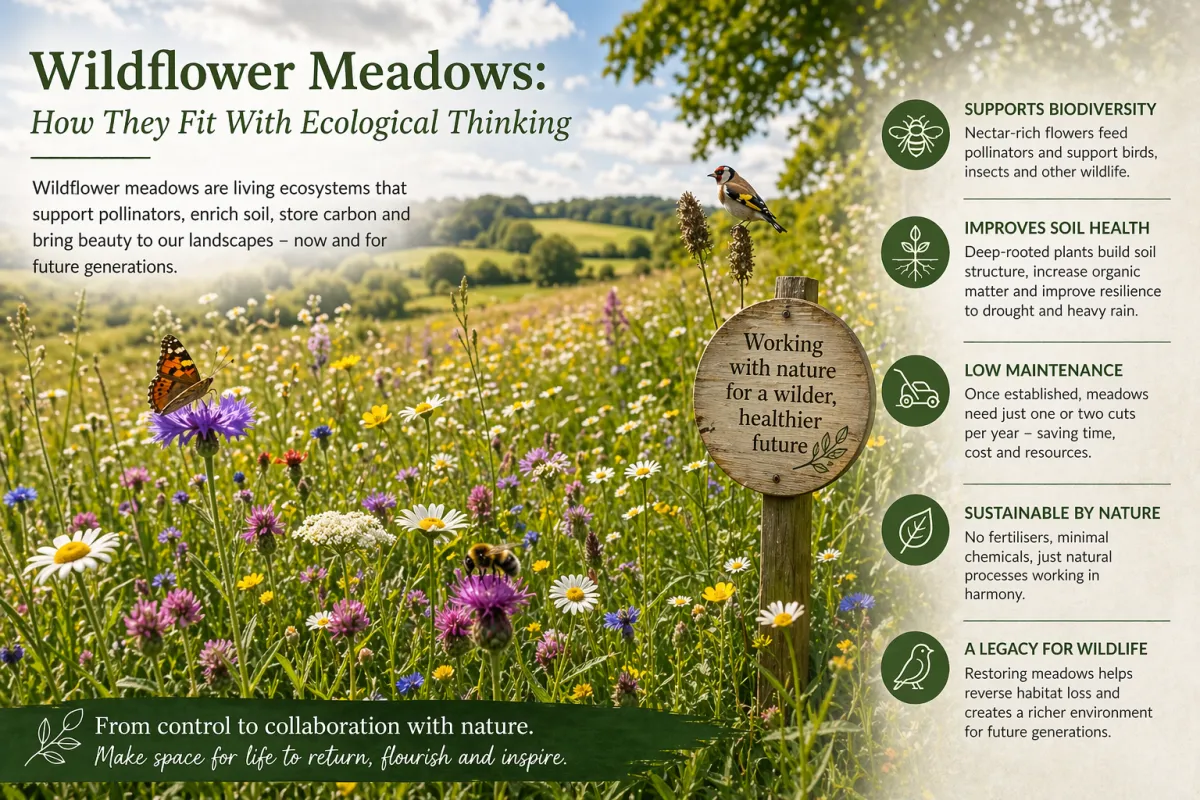
Wildflower Meadows - How They Fit With Ecological Thinking
Wildflower meadows are not just pretty landscapes, they are essential ecosystems, supporting biodiversity, stabilising food chains, and reconnecting people with nature at a time when the UK has lost most of its species-rich grasslands.
Creating a wildflower meadow isn’t just about aesthetics, it’s a meaningful investment in nature, sustainability, and long-term land health. Meadows underpin entire ecosystems. Nectar-rich flowers feed pollinators like bees and butterflies, which in turn support birds and other wildlife, making meadows essential for wider environmental health.
People choose to establish meadows for a range of practical and emotional reasons, often combining environmental benefits with a desire for a more natural landscape.
One of the biggest motivations is supporting biodiversity. In the UK, meadows are among the richest habitats for biodiversity, supporting insects, birds, and mammals. Wildflower meadows provide vital habitat for pollinators such as bees, butterflies, and other insects, many of which are in decline across the UK. A single meadow can become a thriving ecosystem, supporting birds, small mammals, and countless invertebrates. In a world where natural habitats are disappearing, creating even a few acres of meadow can make a real difference.
There’s also the appeal of natural beauty. Unlike formal lawns or heavily managed gardens, wildflower meadows change throughout the seasons. From early spring greens to vibrant summer blooms and softer autumn tones, they offer a dynamic, ever-evolving landscape. Many people find this more relaxing and inspiring than traditional, uniform spaces.
Another key reason is reduced maintenance over time. While establishing a meadow requires effort, once mature it typically needs just one or two cuts per year. This is far less intensive than maintaining large areas of lawn, which require frequent mowing, feeding, and watering. For landowners managing several acres, this can significantly reduce time, cost, and machinery use.
Wildflower meadows also contribute to improved soil health. Their deep-rooting plants help enhance soil structure, increase organic matter, and improve drainage. Over time, this creates more resilient land that can better cope with drought and heavy rainfall, an increasingly important factor with changing climate patterns.
For those interested in sustainability, meadows offer a way to work with nature rather than against it. They require no fertilisers, minimal chemical input, and support natural ecological processes. This makes them an excellent choice for environmentally conscious land management.
The UK has lost the vast majority of its wildflower meadows over the last century, largely due to agricultural intensification and development. Protecting and restoring them is critical to reversing biodiversity decline.
There can also be practical and financial incentives. In some cases, landowners may be eligible for environmental stewardship schemes or grants that support meadow creation and maintenance. Additionally, meadows can be used for traditional hay production or low-intensity grazing.
On a more personal level, many people create wildflower meadows to leave a legacy. Whether it’s transforming unused land, enhancing a property, or contributing to local conservation, a meadow is something that continues to grow and give back year after year.
Ultimately, a wildflower meadow represents a shift in perspective, from control to collaboration with nature. It’s about creating space for life to return, flourish, and surprise you.
